If you have started reading about this corner of the market, you have met the phrase "research peptide" already. It is on the product pages, in the forum threads, in the search box. It is also rarely defined. This piece is the definition, and nothing more than that.
A research peptide is, first, a peptide. And a peptide is one of the most ordinary things in biochemistry: a short chain of amino acids, the same building blocks that make up every protein in every living thing. Where a protein is a long, folded chain, a peptide is a short one. The line between the two is a matter of length and convention rather than a hard rule, but "peptide" generally means a chain short enough to be described by its sequence rather than its structure.
The compounds discussed in this trade are, almost always, synthetic. They are assembled in a laboratory, one amino acid at a time, to match a known sequence. That is a well-established branch of chemistry. The interest, and the commerce, comes from the fact that particular sequences are the subject of ongoing scientific study.
What the word "research" is doing
The "research" half of the phrase is the important half, and it carries two meanings at once.
The first is descriptive. These are compounds that appear in the scientific literature, that laboratories and academic groups study, and that have not completed the long regulatory road that turns a compound into a licensed medicine. They are subjects of research. That is a plain statement of where they sit.
The second meaning is a legal and commercial one. In the United Kingdom, these materials are sold for laboratory research use only. They are not licensed medicines, they are not sold for human use, and a responsible seller's product pages and terms will say so explicitly. We have written a separate piece on exactly what that "research use only" framing means in UK law, and it is worth reading alongside this one.
So when a page says "research peptide", it is telling you two things: what the compound is, and the basis on which it is being sold.
How they are supplied
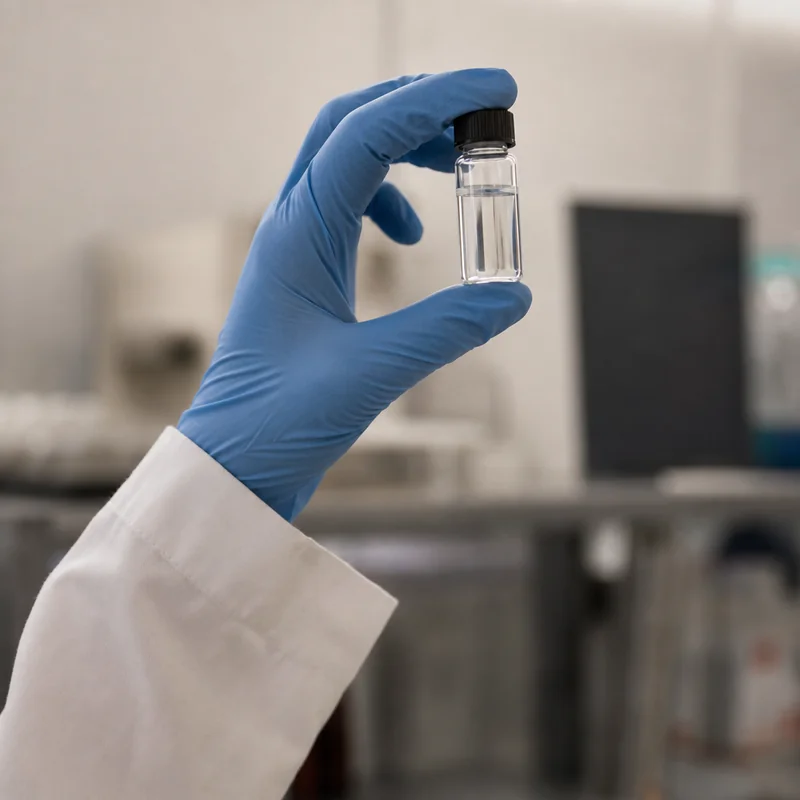
Most research peptides are supplied as a lyophilised powder, sealed in a small glass vial. Lyophilisation is freeze-drying: the water is removed under vacuum, leaving a dry solid that is far more stable than a solution would be. The amount in the vial is usually small, measured in milligrams, and the vial is sealed because the powder is sensitive to moisture and air.
This is why the photographs in this corner of the trade always look the same: a little clear vial, a cap, a label, a white or off-white solid at the bottom. That is simply the standard form the material takes.
Storage and handling
Because the compounds are sensitive, storage is part of the subject. As a general rule, sealed lyophilised material is kept cold and dry, away from light, and a supplier worth dealing with will state the storage conditions for what they sell. The handling guidance on a good listing is one of the clearer signals that the seller understands the material rather than simply reselling it.
This is also one of the things we score suppliers on. A listing that documents the compound properly, with storage and handling guidance, is doing more for the buyer than one that shows a name and a price and nothing else.
Purity, and why testing exists
The single most discussed property of a research peptide is its purity, meaning how much of what is in the vial is the intended compound and how much is something else. This is not a small or academic question. Two vials with the same label can contain materially different things.
This is the reason the Certificate of Analysis exists, and the reason it comes up constantly on this site. A Certificate of Analysis is the document a third-party laboratory produces after testing a batch: what the compound is, how pure it is, and what else was detected. We have a full guide to how to read a Certificate of Analysis, and a companion piece on what laboratory accreditation adds to one. If you take one idea from this article into the rest of the site, let it be that the test paperwork is the part that turns a label into evidence.
A short glossary
- PeptideA short chain of amino acids. Shorter than a protein, defined by its sequence.
- SequenceThe specific order of amino acids that defines a particular peptide.
- LyophilisedFreeze-dried. The standard supplied form: a dry, sealed powder.
- ReconstitutionThe laboratory step of returning a lyophilised powder to solution. Handling guidance, not a use instruction.
- Certificate of AnalysisThe third-party laboratory document reporting a batch's identity and purity.
- Research use onlyThe legal and commercial basis on which these materials are sold in the UK. Not licensed medicines, not for human use.
The takeaway
A research peptide is a short, synthetic chain of amino acids, studied in the scientific literature, and sold in the UK for laboratory research use only. That is the whole of the definition. Everything else this site covers, the suppliers, the certificates, the regulation, the vetting, sits on top of that one plain fact.
If you want the next layer, our guide to vetting a UK peptide company walks through what to actually check once the terminology is clear.