When a peptide seller tells you their products are tested, the obvious follow-up question is who did the testing. If the answer involves the letters UKAS or the number 17025, you are dealing with a different category of test. Here is what that actually means.
The phrase "lab-tested" appears on more peptide product pages than almost any other. It is also, on its own, close to meaningless. A test report from a named laboratory says something. A test report from an accredited laboratory says more. Knowing the difference takes about five minutes of reading.
What ISO/IEC 17025 actually is
ISO/IEC 17025 is an international standard, jointly published by the International Organization for Standardization (ISO) and the International Electrotechnical Commission (IEC), that sets out general requirements for the competence of testing and calibration laboratories.
In plain English, it is a checklist. The standard covers how the laboratory manages its samples, how it calibrates its instruments, how it documents its methods, how it handles uncertainty in measurement, how it deals with non-conforming work, and how it ensures the people doing the testing are competent to do it. A laboratory that holds ISO 17025 accreditation has been independently audited against that checklist and found to meet it.
The role of UKAS
In the United Kingdom, the body that performs those audits is UKAS, the United Kingdom Accreditation Service. UKAS is the only national accreditation body recognised by government. When a UK-based laboratory says they are "ISO 17025 accredited", what they should mean is that UKAS has audited them and issued a certificate to that effect.
That certificate has a scope. A lab might be accredited for HPLC analysis of certain compounds, but not for others. Accreditation is not a generic stamp, it is a list of specific tests the laboratory has demonstrated competence in performing. The UKAS public register lets anyone look up an accredited body and see exactly what is in their scope.
Why this matters for a peptide buyer
The chain of trust on a peptide test report runs like this. The seller says the product is what it claims to be. The Certificate of Analysis is the evidence. The laboratory that performed the test is the third party. And the accreditation body, UKAS in the UK, is the body that has checked the laboratory.
If any link in that chain is missing, the chain is weaker than it looks. A test report from an unnamed lab is the seller telling you the report exists. A test report from a named-but-unaccredited lab is a third party telling you what they found, but with no external check on whether their methods are sound. A test report from a UKAS-accredited lab for the relevant test method is the version with all four links intact.
How to check
Two steps. First, find the laboratory on the public UKAS register at ukas.com. If they are accredited, they will appear. Their accreditation number, the standard they hold, and their accredited scope will all be listed.
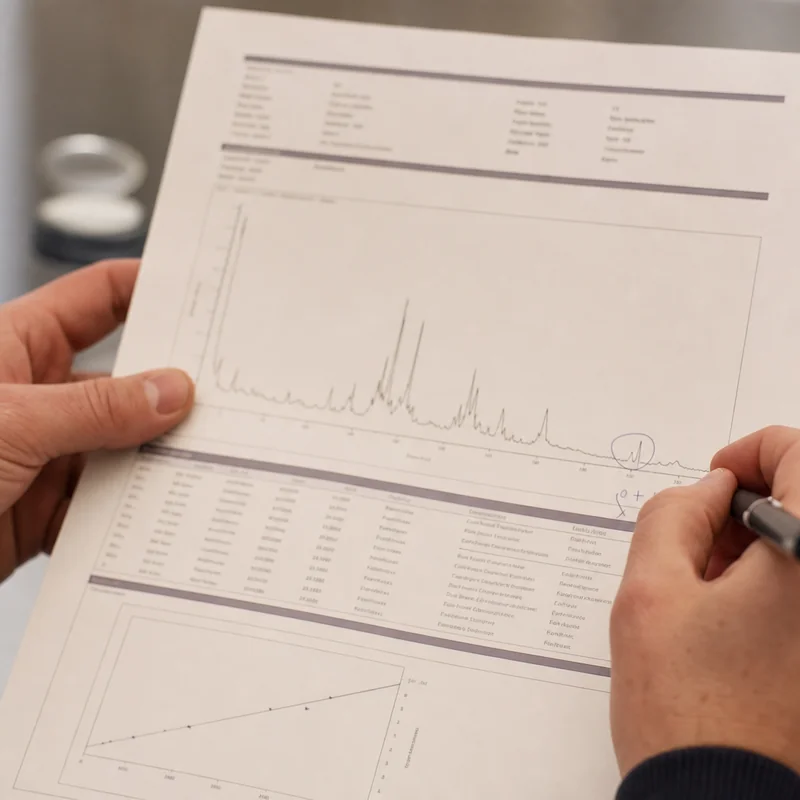
Second, check whether the specific test mentioned on the Certificate falls inside the laboratory's accredited scope. A lab might hold 17025 for one analytical method but use a non-accredited method for another test. The Certificate should make clear which methods it has used.
What if the lab is not accredited?
The honest answer is that an unaccredited lab is not automatically a bad lab. Plenty of competent analytical work happens at laboratories that, for whatever reason, do not hold UKAS accreditation. Accreditation costs money and takes time. Some labs choose to put that effort into other things.
What it does mean is that you, as a buyer, have less external assurance about the lab's methods. You are relying on the lab's own statements about its competence, rather than UKAS's audit of it. That is a step less protective. Whether it matters to you depends on what you are buying and why.
Some of the peptide-testing labs that come up in this trade are based outside the UK, in jurisdictions with their own national accreditation bodies. ISO 17025 accreditation is a mutually recognised standard, so a 17025 accreditation from a peer body, like DAkkS in Germany or A2LA in the United States, counts on the same basis.
The takeaway
When you are reading a peptide product page that says "lab tested", the right next question is "by whom, against what standard, and accredited by what body?". A seller who can answer that quickly is operating in the part of the trade where the paperwork has been done. A seller who cannot is operating somewhere else.
For the wider framework, our guide to vetting a UK peptide company walks through how this fits with the other things a buyer should check.